New analysis from Jobs and Skills Australia (JSA) suggests that while completing a full vocational qualification delivers the strongest outcomes, learners who partially complete vocational education and training studies can still achieve significant employment and income gains.
Drawing on data from the VET National Data Asset (VNDA), the report examines students whose first VET enrolment occurred in the four years between 2015-16 and 2018-19 and who completed at least one training unit but did not ultimately obtain a qualification.
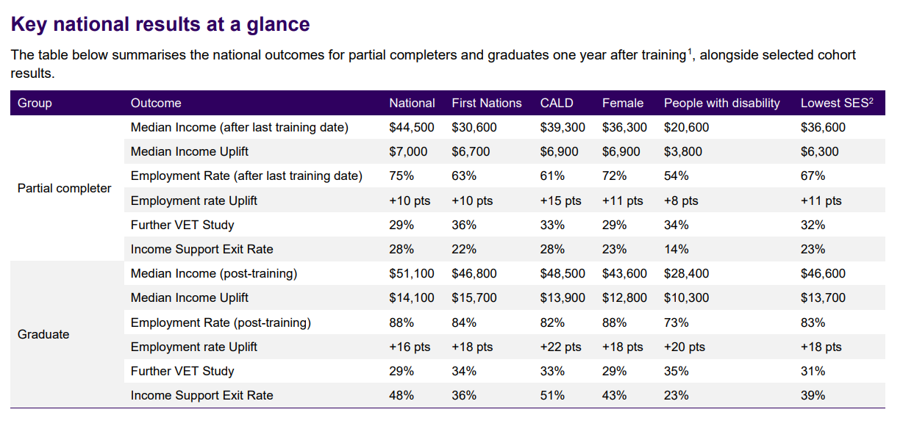
JSA found that partial completers studied for an average of 146 days, compared with 296 days for full qualification completers. Despite the shorter duration, median employee income increased by $7,000 in the year after training, while employment rates rose by 10 percentage points to 75%. Nearly half (48%) of those not employed before training were employed within a year.
The strongest gains were recorded among younger learners. For those aged under 20, median income increased by $16,800 and employment rose from 44% to 75% following training.
The report also found reduced reliance on income support, with 28% of partial completers no longer receiving support one year after training. Among apprentices and trainees, outcomes were particularly strong, with a 90% employment rate and median income growth of $13,800.
JSA noted positive outcomes across regional, First Nations, culturally and linguistically diverse (CALD), and low socio-economic status cohorts. The analysis also found that partial completion often forms part of a broader learning pathway, with 29% of learners undertaking further VET study in the year of, or following, their partial completion.
The data also shows that those students who complete a VET qualification, showed greater gains than those who partially complete (see table below). This highlights the ongoing value of full qualifications.
Source: Jobs and Skills Australia, Partial VET completion: Insights on outcomes and pathways, VET National Data Asset, June 2026