The Powering Skills Organisation Jobs and Skills Council this month released its Electrician Workforce Capacity Study: Why more apprentices are essential and who holds the keys to growth research paper.
The paper reveals that renewable generation, transmission, housing, data centres, electrification, and infrastructure are converging on the same licensed workforce. Earlier estimates identified a need for about 42,500 additional electricians by 2030, while newer demand could require roughly 30,000 more energy trades workers, many of them electricians.
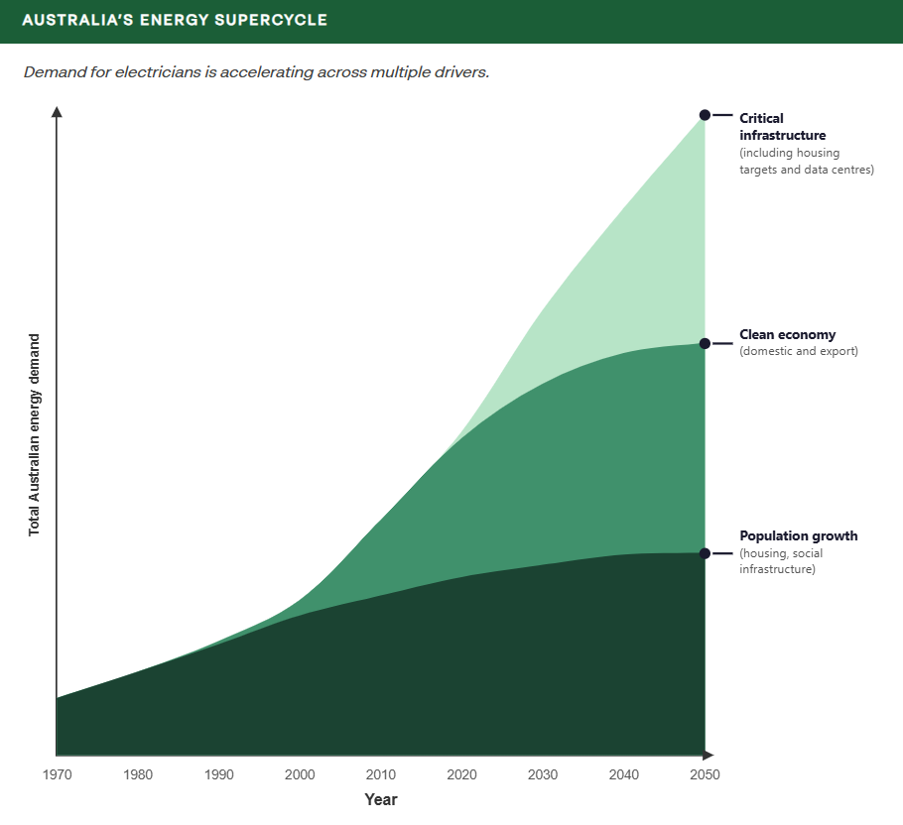
Source: PSO, Electrician Workforce Capacity Study: Why more apprentices are essential and who holds the keys to growth, August 2026
PSO argues that the central constraint in the economy is not a lack of willing apprentices – interest in electrical careers is strong, recruitment is comparatively easier than for qualified workers, and electrician apprentices achieve a 70% completion rate, well above the VET average.
While electrical contracting businesses train 71% of electrician apprentices and employ about 56% of licensed electricians, only one-third of Australia’s approximately 48,000 electrical contracting businesses currently employs an apprentice. This represents latent capacity, particularly among small and medium businesses, but activating it requires a stronger employer value proposition. In particular, removal of barriers that inhibit employer investment – employer cost being the most cited barrier by employers.
Employing an electrical apprentice costs an estimated $200,000 to $250,000 over four years. Wages account for about 54% of costs, while supervision is the second-largest component. Employers also face workload, cashflow and retention risks, including the possibility that other businesses capture the benefit during or after training.
The findings of this PSO report align with research by Australian Industry Group’s Centre for Education and Training showing that the economic realities of employing apprenticeships and traineeships are influenced by a complex range of direct and indirect costs, along with broader economic conditions. This represents a complex economic equation – one that employers of all sizes and across industries report is increasingly challenging.
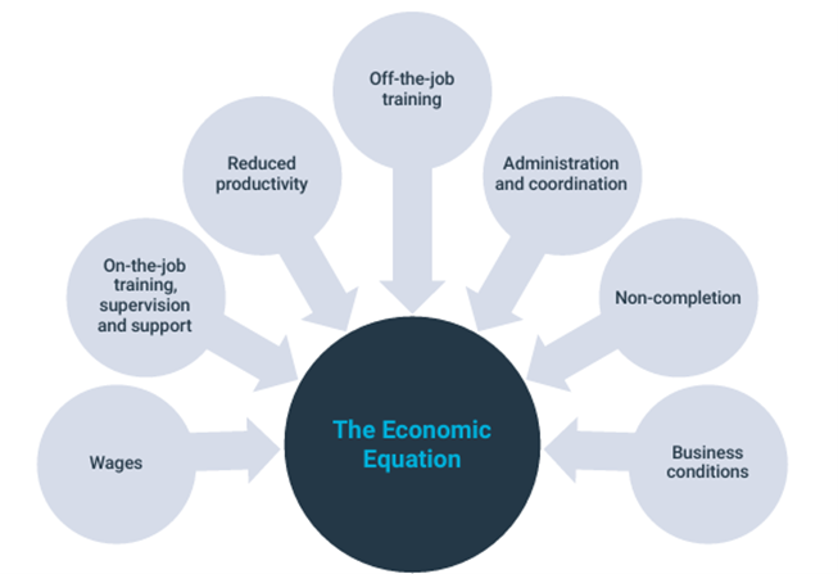
Source: Australian Industry Group Centre for Education and Training: Apprenticeships and traineeships: The employer perspective, June 2025
A sharp focus is needed on ensuring Australia’s apprenticeship system remains viable for employers into the future, as without an employer there is no apprenticeship. Read the Centre’s recent research and statements below: