

You would be hard pressed to find any Australian who doesn't know someone who has done an apprenticeship or traineeship. This form of structured workplace training has endured because it works: learn by doing, earn while learning, and develop real skills in real workplaces that translate into lifelong careers.
Employers value the system. More than 8 in 10 employers surveyed by Australian Industry Group identify apprentices and trainees as important or very important to their business.
There are also real benefits for individuals. When comparing all of the post-school pathways, by age 25, a person who has undertaken an apprenticeship or traineeship is most likely to be employed, is earning the most and has among the highest job satisfaction.
If Australia is serious about increasing housing supply, delivering major infrastructure, managing the energy transition and delivering high-quality services and local manufacturing, we cannot do it without a steady pipeline of skills.
We are being reminded again of the importance of strengthening Australia’s sovereign industrial capability in globally uncertain times. Sovereign capability can only be strengthened if we also strengthen the human capability that underpins it.
And that means we need a steady pipeline of apprentices and trainees commencing and completing training in the myriad of skilled occupations that are critical to Australia’s current and future skills needs. In recent years, this pipeline has been shrinking.
Today’s declining commencements are tomorrow’s severe skill shortages—that risk slowing projects, raising costs, and placing a further brake on productivity.
Skilled workers like carpenters, welders, electricians, hairdressers and care workers don’t just appear overnight. They are developed over extended periods of time through apprenticeships and traineeships that combine training with real work undertaken in real workplaces. In many cases, it takes three to four years for an apprentice to become fully qualified as a skilled tradesperson.
The latest data released on apprenticeship and traineeship commencements by the National Centre for Vocational Education Research paints a worrying picture for the future pipeline of skills in many critical areas.
In the 12 months to September 2025:
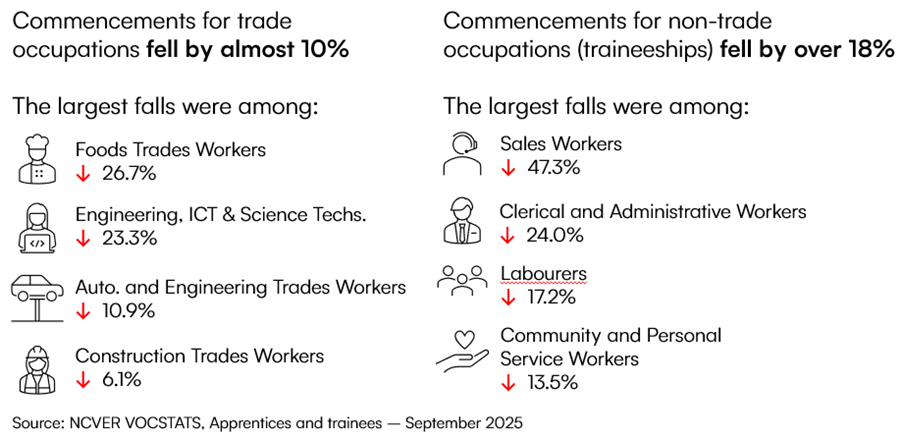
While there are some potential green shoots in the most recent quarter related to commencements in construction-related qualifications, it is too soon to know if this is reflective of a longer-term trend.
While the falls in commencements in key occupations over the last twelve months referenced above are concerning, this concern amplifies when looking at commencement trends over a longer period of time.
The number of apprenticeship and traineeship commencements annually was fairly consistent between 2015 and 2019. Significant volatility occurred during 2020 to 2022, driven by the initial impacts of the pandemic followed by significant federal government stimulus, including in the form of generous wage subsidies for employers of apprentices and trainees.
Since 2023, alongside the cessation of pandemic related stimulus and subsidies, commencements have reverted to levels more closely resembling pre-pandemic levels. In the case of traineeships, declines in commencements have been particularly pronounced as a result of the reduction and removal of a range of incentives for employers to employ trainees during this period.
Governments across the country have recently been reporting record high levels of apprentices and trainees in training. While technically accurate, this masks a less positive reality – once this ‘bubble’ of pandemic-era commencements flows through the system in the next 1-2 years, more recent rates of commencements mean that these in training numbers will almost certainly fall off a cliff.
While commencements have fallen across the board, the picture is not uniform across States and Territories. Looking across jurisdictions, two states stand out as warranting particular attention.
Commencement trends in Victoria are worrying. In the twelve months to September 2025, commencements in trade occupations fell by 18.2%. This decline far exceeds any other state or territory. At the same time, the Victorian Skills Authority projects that between 2025-2035, the construction industry alone will require 162,000 new workers – the second highest growing industry behind Healthcare and Social Assistance.
While commencements in Queensland are tracking more positively than some other jurisdictions, this remains of concern in context of the sheer scale of workforce demand on the horizon. Significant economic activity across Queensland is underpinned by skilled trades, not least the infrastructure associated with the 2032 Games that has a fixed delivery timeline.
Recent research projects an average workforce shortfall of nearly 20,000 workers across each of the seven years to 2031-32 in the Construction sector in Queensland alone, peaking at a shortfall of 35,000 in 2027-28. Boosting apprenticeships in Queensland must be part of a solution to ensure that this skills demand can be met without crippling the range of other industries and priorities that also rely upon these same skills.
Workforce shortages are a key constraint on business activity. Technicians and Trades Workers, for which apprenticeships and traineeships are a primary skills pipeline, make up over half of all occupations classified as in persistent shortage by Jobs and Skills Australia. JSA also found that industries with higher workforce shortage, such as Construction, Mining and Healthcare and Social Assistance, also had lower productivity growth over the last five years.
Strong demand is projected to continue. For example, Jobs and Skills Australia projects that over the next decade an increase of 195,000 Technician and Trades Workers and 236,100 Community and Personal Service Workers will be required.
BuildSkills Australia reports that meeting Australia’s ambitious goal to build 1.2 million new homes by 2029 under the National Housing Accord will require a significant expansion of the residential construction workforce, an extra 116,700 workers, which equates to an increase of roughly one-quarter over a “business as usual” scenario.
Technicians and Trades Workers are also vital to Australia’s manufacturing industry. A highly skilled workforce underpins both global competitiveness for Australian manufacturers and the important sovereign capability that this sector provides.
Given current shortages and the projected demand for skills in our economy in the current decade and beyond, apprenticeship and traineeship commencements that simply mirror the commencement numbers in the years prior to the pandemic will not be sufficient. Australia needs an urgent and sustained step change in the numbers of apprentices and trainees participating in the system to meet our skill needs.
A renewed and concerted effort needs to be placed on ensuring the apprenticeship and traineeship system is and remains a cornerstone of our skills development system. This can only occur if a renewed and concerted effort is placed on ensuring the system remains viable for employers into the future.
Without an employer, there is no apprenticeship.
The risk of inaction is immense and will present in the form of persistent and embedded skills shortages that will continue to stifle business activity, constrain growth and limit Australia’s global competitiveness.
It is important to note that commencements are not the only piece of the puzzle. Supporting retention and completion of apprentices is also important. As with any training and employment arrangement, it is unrealistic to expect that 100% of those who commence will complete.
Apprenticeships and traineeships already generally achieve higher completion rates than many other post-school education pathways. And recent work by the National Centre for Vocational Education Research indicates that when completion rates are calculated for individuals, as opposed to training contracts, trade apprenticeship completion rates are likely higher than has been commonly publicly reported for many years, at over 60%.
The proportion of apprentices and trainees that complete their training varies across industries and is influenced by a myriad of factors. Lifting completion rates requires a nuanced discussion of the issues and potential policy responses. But a focus on improving completions should only occur alongside clear recognition of the reality that lifting completions alone cannot deliver the uplift required when there is a diminishing pool of commencements.
The economic realities of employing apprenticeships and traineeships are influenced by a complex range of direct and indirect costs, along with broader economic conditions.
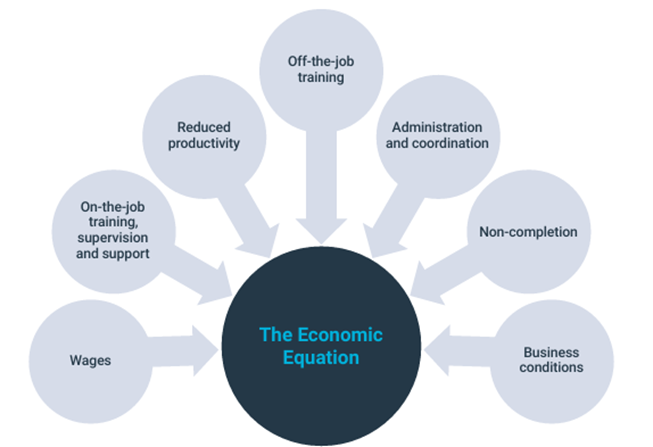
Policy settings by both the federal and state governments matter and directly impact this equation. This economic equation, along with the increasing cost and complexity of the system as reported by employers, must remain at the heart of policymaking in relation to this system. These issues, and recommendations for actions that can be taken in response, are outlined in more detail in research undertaken by the Centre for Education in 2025.
This research also highlights the critical role of employer incentives in ensuring that apprenticeships and traineeships are viable for employers. It found that around half of employers surveyed report that their employment of apprentices and trainees would reduce if they no longer received financial incentives.
It is important to remember that the most recent available commencement data relates to commencements in late 2025. The headwinds for businesses employing apprentices and trainees have only increased since then.
On 1 January 2026, the Australian Government reduced employer incentives for employers taking on apprentices and trainees in priority sectors outside of the housing and new energy sectors.
When these changes were announced in December 2025, Australian Industry Group stated that these changes will make taking on an apprentice less affordable in industries important for lifting our sovereign manufacturing capability and delivering high-quality services in the community and aged care sectors. For those occupations that will receive no incentives, further reductions in the structured work-based training can be anticipated and the impact this will have on important skills and sectors of the workforce is of deep concern.
In recent weeks disruption and uncertainty has significantly impacted businesses across our economy linked to the Middle East conflict. There is clear evidence from previous disruptions that this uncertainty creates further difficulty and hesitation for businesses in employing apprentices and trainees, just like any other significant and long-term investment decision.
There are some occupations for which a qualification can be attained through either a work-based training pathway (i.e. an apprenticeship or traineeship) or through an institutional training pathway that involves no employment relationship. Examples include commercial cookery, individual support, early childhood and business administration.
With the expansion of Free TAFE in recent years, it is likely that reductions in apprenticeship and traineeship commencements in some areas are offset to some degree by additional individuals undertaking these qualifications through Free TAFE.
It is clear that in a number of areas, the collective impact of a range of policy settings, which includes the reductions in employer incentives outlined above, is leading to a systemic reduction in structured work-based training. The impact this will have on important skills and sectors of the workforce is of deep concern.
While institutional delivery will always have a role in the overall skills system, the workplace is an important site for successful, context-driven learning. Structured work-based training delivers many benefits for both employers and the individuals undertaking it.
Australian Industry Group has previously identified that in the last decade, the focus on workplace training in education and training policy settings and associated funding arrangements in Australia has diminished. Reforms in recent years have generally focussed on uplifting institutional-based delivery, which has potentially occurred at the expense of workplace delivery models.
In our pre-budget submission for the 2026-27 Federal Budget, Australian Industry Group identified an urgent need to ensure investment in apprenticeships and traineeships is sufficient to deliver national priorities of housing and construction, manufacturing and sovereign capability and high quality care and support services.
The submission advocated for employer incentives to be available to all priority occupations in a consistent manner, at or above levels that existed in 2025. This will support continued apprenticeship and traineeship opportunities for Australians and prevent labour market distortions caused by differing incentives across similar occupations.
The submission also advocated for priority to be placed on ensuring that skills system and funding settings encourage and enable training to be delivered in a workplace context wherever relevant.
Apprenticeships and traineeships underpin the skills required to deliver upon many of our biggest priorities as a nation. We need to back them and turn around declining commencements. Fast.
This Research Note is accompanied by the following case studies:
