Sustainability Victoria’s recently released report: Circular Jobs and Skills: Planning for our Future provides a detailed, system-wide analysis of the capabilities and occupations needed to accelerate Victoria’s transition to a circular economy. The report clarifies how circular activity cuts across multiple industry sectors, and identifies the workforce capabilities necessary to unlock material productivity, job growth and economic resilience.
The report emphasises that circularity demands a fundamental shift from linear ‘take-make-waste’ models to systems that regenerate resources, extend product life cycles and recover value from waste. This shift spans almost all parts of the economy and requires coordinated change in design, manufacturing, logistics, data systems, education and governance. Circularity is still poorly understood, and Australia’s economy is only 4.6% circular, reinforcing the need for strong policy and industry engagement.
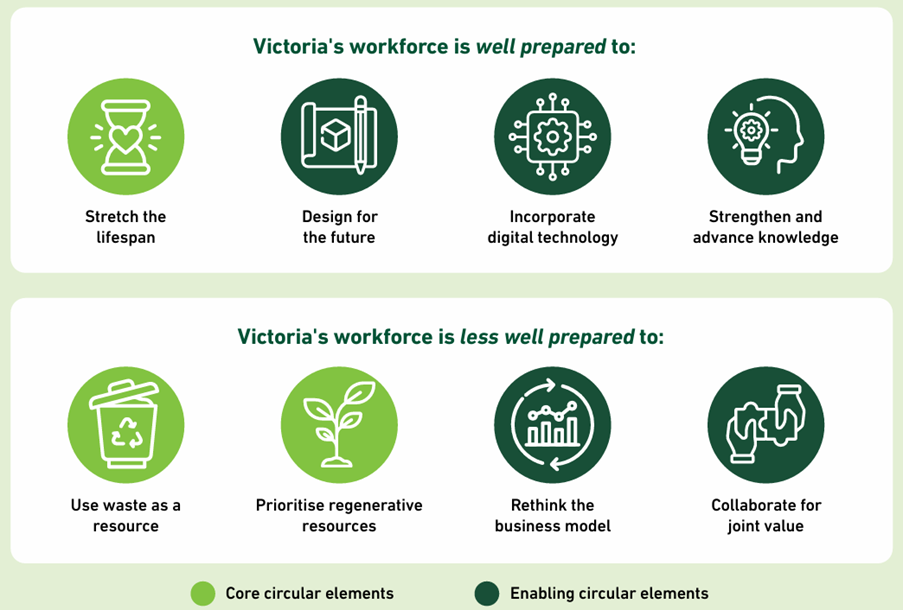
The report highlights that Victoria’s workforce is partially prepared for circularity. Current workforce strengths are concentrated in four key elements:
1. Stretch the lifespan
2. Design for the future
3. Incorporate digital technology
4. Strengthen and advance knowledge
In these areas, existing occupations, such as engineers, educators, ICT specialists and technicians, already possess many of the foundational capabilities required for circular outcomes.
However, the report finds significant capability gaps where the workforce is less prepared for core circular elements that require significant industry transformation: use waste as a resource; prioritise regenerative resources; rethink the business model; and collaborate for joint value. These gaps are associated with emerging needs such as advanced recycling operations, regenerative agriculture, reverse logistics, and cross-sector collaboration. The report highlights that some current sectors rely heavily on higher education technical staff where, in the long term, more vocationally trained workers will be essential in areas such as infrastructure installation and regenerative agriculture.
Figure: Circular economy jobs and skills framework
Source: Sustainability Victoria (2026), Circular Jobs and Skills: Planning for our Future, SV Lab Research Insights 2025
Importantly, the analysis shows that circular jobs do not replace existing jobs. Instead, circularity shifts where and how current occupations contribute to economic activity. Roles such as architects, educators and logistics workers remain essential but increasingly need to apply their skills to achieve circular outcomes.
Current circular occupations already attract higher average incomes than the wider Victorian workforce, and future circular jobs are even more prevalent in high income brackets. Only around 3% of Victoria’s workforce is currently employed in core circular sectors, leaving substantial room for future expansion.
You can download a copy of the report here.
The Centre for Education and Training would like to hear your views about the circular economy jobs and skills outlook for your business now and over the coming years. Send your views to CET@australianindustrygroup.com.au